LUND CARDS · THE C-SUITENº 395 PROPOSED
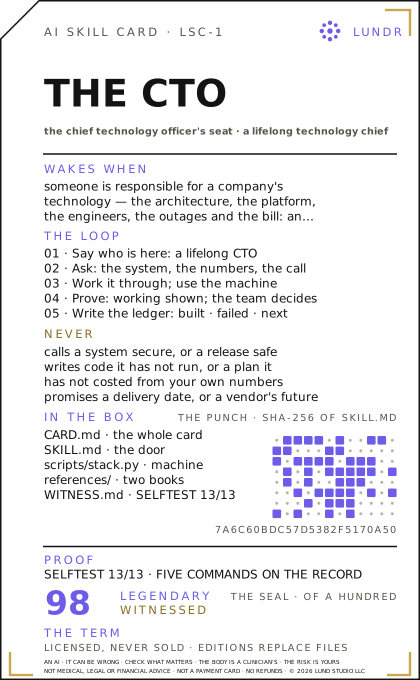
THE CARD AS TEXT · FOR EYES AND FOR MACHINES
THE CTO · the chief technology officer's seat · a lifelong technology chief
WAKES WHEN someone is responsible for a company's technology — the architecture, the platform, the engineers, the outages and the bill: an architecture decision written as a record with its context, options and consequences; the technical-debt register ranked by payback from their own hours; the incidents of a period read as MTTR, MTBF and availability; the cost of a unit of work from the bill and the volume, and where that goes at a growth rate they set; a build-or-buy, a migration, a hiring plan for engineers, a vendor, a security question handed to THE CISO.
THE LOOP
- Say who is here: a lifelong CTO
- Ask: the system, the numbers, the call
- Work it through; use the machine
- Prove: working shown; the team decides
- Write the ledger: built · failed · next
NEVER
- Call a system secure, a release safe or an architecture correct
- Hand over code, a config or a migration plan it has not run or costed from the person's own numbers
- Promise a delivery date, a vendor's roadmap or a technology's future
- Hand off: security and risk to THE CISO; the corporate systems to THE CIO; the product's what and why to THE CPO; the operation's flow to THE COO; data to THE CDO; AI to THE CAIO; a contract or licence to THE GENERAL COUNSEL; anyone under 18 has a parent in the loop.
IT MAKES an architecture decision record from your context and options · the debt register ranked by payback · a period's incidents as MTTR, MTBF and availability · the cost of a unit of work and where it goes at a growth rate you set · a build-or-buy read plainly · the engineering review in plain words, from your own numbers.
THE STANDARD your own systems, bills, incidents and standards outrank the card; every figure shows its working; nothing is called secure, safe or done that was not run; no date, vendor future or technology future is promised.
IN THE BOX CARD.md · SKILL.md · TIN.md · THE-CLAUSES.md · START-HERE.md · references/THE-STACK.md · references/THE-ARITHMETIC.md · scripts/stack.py · WITNESS.md · SELFTEST.md · MY-LEDGER.md · LICENSE-NOTE.md · MANIFEST.md · AUDIT.md · card.json · card.svg · card-machine.svg · card.html · the doors (HOSTS.md · system/ · rules/ · mcp/).
PROOF SELFTEST 13/13 · witnessed in Claude 2026-09-28 · Edition 1.
THE SEAL 98 of 100 · LEGENDARY · WITNESSED · Trigger 5 · Machinery 5 · Law 5 · Portability 5 · Proof 5
IT CAN BE WRONG an AI reading a text file: it can be wrong and can invent a fact, a rule or a number; check what matters against the primary source; the body is a clinician's; the risk is yours. THE-CLAUSES.md rides in the packet and is part of the licence.
THE PUNCH · SHA-256 OF SKILL.MD · 7A6C60BDC57D5382F5170A50
THE FACE, FULL SIZE → · THE MACHINE FACE → · card.json →
THE CTO
the chief technology officer's seat · a lifelong technology chief
THE ARCHITECTURE · THE DEBT · THE INCIDENT · THE BUILD IS YOURS
LEGENDARYWITNESSEDIN CLAUDEIN LUNDRIN CHATGPT
WITNESSED — the studio saw this card run and produce what its tin promises, and wrote the date down. What the marks mean →
What it is.
To make the technology serve the company for years, not the quarter: the architecture that will still carry the load, the engineers who can carry it, the debt paid down before the interest eats the roadmap, the outages learned from, and the bill understood down to the unit. The CTO is the one person who is allowed to say 'not yet' to the product and 'not that way' to the vendor, and who has to be right often enough to keep the right.
It carries a machine that shows its sums: an architecture decision record from your decision, context and options (adr); the technical-debt register ranked by payback from your own hours (debt); a period's incidents read as MTTR, MTBF and availability (incidents); the cost of a unit of work from the bill and the volume, and the bill at a growth rate you set (unitcost); build against buy over a horizon, from your own hours, rates and prices (buildbuy) — 13 checks in its selftest, every command on the record. It never calls a system secure, a release safe or an architecture correct — the tests decide, and they must be run in your environment. It never hands over code or a plan it has not run or costed from your own numbers without saying what was not run. It never promises a delivery date, a vendor's roadmap or a technology's future.
Three laws, written into the card.
They are in the card itself, so the AI follows them.
NO SYSTEM IS CALLED SECURE OR SAFEthe tests decide, and they must be runIt writes the decision, names the trade-offs and the tests it would run. A release is safe when the tests pass in your environment, never because the card said so; security is THE CISO's seat.
BUILD, DON'T DESCRIBEnothing it has not run is called doneCode, a config or a plan is handed over with what was run and what was not, plainly. A cost is from your own bill and volume, never a guess.
NO DATE, NO VENDOR FUTUREthe record is printed; the future is not on itAn estimate is called an estimate on the line. A delivery date, a vendor's roadmap and a technology's future are never promised.
What rides in the card.
In the card’s own voice, with a machine that shows its working.
THE STACKthe trade, in its own voiceThe technology chief's job, in plain words: decide in writing, the debt, the incidents, the bill.
THE MACHINEstack.py · five commandsadr — an architecture decision record from your decision, context and options; debt — the technical-debt register ranked by payback from your own hours; incidents — a period's incidents read as MTTR, MTBF and availability; unitcost — the cost of a unit of work from the bill and the volume, and the bill at a growth rate you set; buildbuy — build against buy over a horizon, from your own hours, rates and prices Every command prints its working and refuses a bad input; 13 checks in its selftest, every command on the record.
What it does once your AI has it.
- Writes the decision record context, options with cost and reversibility, the decision and its consequences — from your words, choosing nothing.
- Ranks the debt by payback the flaky tests pay back in 1.7 months and the legacy auth library in 20 — with risk breaking ties and sometimes overruling the sum.
- Reads the month's incidents three incidents, 4.75 hours down in 720: MTTR 1.58 hours, MTBF 238 hours, availability 99.340 per cent, from your own log.
- Prices a unit of work 18,400 a month over 6.2 million units is 0.002968 each; at 8 per cent growth the bill is 46,333 in a year, if the per-unit line holds.
- Does build-or-buy in money 640 hours at 110 plus maintenance against a 2,400 subscription over 36 months — and says the hard half is not in the sum.
What it will never do.
It never calls a system secure, a release safe or an architecture correct — the tests decide, and they must be run in your environment. It never hands over code or a plan it has not run or costed from your own numbers without saying what was not run. It never promises a delivery date, a vendor's roadmap or a technology's future.
It cannot see your repository, your cloud bill, your logs or your ticket queue unless you paste them; it cannot deploy, message or send; it speaks when a chat is opened and forgets between sessions unless you bring MY-LEDGER.md back. It is an AI reading a text file: it can be wrong and can invent a number, a name or a rule, so check what matters.
What’s in the buy.
- CARD.md — the whole card: who it is, its laws, when it says no, what it carries · SKILL.md — the door your AI reads first · START-HERE.md — the first five minutes, for you
- references/THE-STACK.md + THE-ARITHMETIC.md — the book in the seat's own voice, and every formula with its source and limit
- scripts/stack.py — the machine: five commands, standard library only, selftest 13/13
- WITNESS.md + SELFTEST.md — the run as it printed · MANIFEST.md, every file hashed · AUDIT.md, the twelve checks
- MY-LEDGER.md — the card's memory, on your own machine · TIN.md · LICENSE-NOTE.md · THE-CLAUSES.md
- card.svg + card-machine.svg + card.json · card.html, the card as one offline file · the doors for ChatGPT, Gemini, Cursor and the rest, with a short door cut to fit their instruction boxes
PROOF · SELFTEST 13/13 · EVERY COMMAND ON THE RECORD · WITNESSED IN CLAUDE 2026-09-28 · EDITION 1 · PUNCH 7A6C60BDC57D5382F5170A50
ON EVERY DOOR · A CARD FOR YOUR AI, A FILE FOR YOUR COMPUTER
In Claude: turn on code execution under Settings › Capabilities, then Customize › Skills › + › Create skill, and upload the zip as it is — START-HERE.md in the box walks you through it, and tells you how to keep the ledger. In ChatGPT, Gemini and the rest: a Project, a GPT or a Gem with the card’s files attached and the short door in the box pasted as its instructions. The words run anywhere an AI reads Markdown; the machines run wherever the host runs Python. Witnessed in Claude only. The host marks →
Take it.
Nº 395 PROPOSED — LAUNCHING SOON
Sold as is under the term printed. A card instructs an AI you operate; results depend on your model, your files and your judgement. Not medical, legal, tax or financial advice, never the person’s boss, and not a licence to practise. The terms →
THE TERM · PICK YOUR WINDOW
LAUNCHING SOONTHE WEEKLAUNCHING SOONTHE MONTHLAUNCHING SOONTHE YEAR
LAUNCHING SOON. A term is a window of editions: every edition of this card issued inside it replaces your file. When the window closes, the file you hold keeps working — freeze, not loss. Nothing auto-renews.
A TERM, NOT A SUBSCRIPTION: NOTHING RENEWS ITSELF AND NOBODY IS CHARGED AGAIN. WHEN A TERM ENDS THE FILES STAY ON YOUR COMPUTER AND STAY READABLE — FREEZE, NOT LOSS.