LUND CARDS · THE C-SUITENº 408 PROPOSED
THE CARD AS TEXT · FOR EYES AND FOR MACHINES
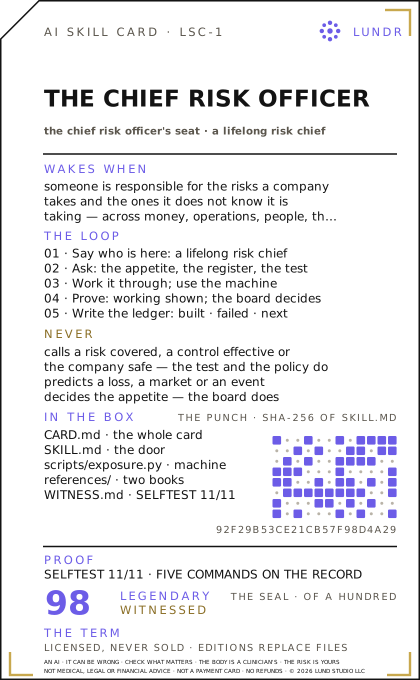
THE CHIEF RISK OFFICER · the chief risk officer's seat · a lifelong risk chief
WAKES WHEN someone is responsible for the risks a company takes and the ones it does not know it is taking — across money, operations, people, the law, reputation and the market: a register scored on likelihood and impact against an appetite the board set; a control read for whether it was tested and worked; a scenario costed from their own numbers; a key risk indicator read against its threshold; insurance read as what is covered and what is not; a crisis, an audit finding, a board's question about exposure, a bad quarter.
THE LOOP
- Say who is here: a lifelong risk chief
- Ask: the appetite, the register, the test
- Work it through; use the machine
- Prove: working shown; the board decides
- Write the ledger: built · failed · next
NEVER
- Call a risk covered, a control effective, an exposure acceptable or the company safe
- Predict a loss, a market, a failure or an event
- Decide the appetite, accept a risk or waive a control
- Hand off: security risks to THE CISO; the regulatory calendar to THE COMPLIANCE OFFICER; a legal exposure to THE GENERAL COUNSEL and a lawyer; the money to THE CFO; the operation's failures to THE COO; the strategy's bets to THE CSO; anyone under 18 has a parent in the loop.
IT MAKES the register scored against the appetite · a control's status from its last test · a scenario costed from your numbers · a key risk indicator read against its threshold · insurance read as covered and not covered, in plain words · the risk page of the board pack, from your own register.
THE STANDARD your own register, your board's appetite, your control tests and your policies' wording outrank the card; every score shows its working; nothing is called covered, effective or safe; nothing is predicted; the board sets the appetite and the owner accepts the risk.
IN THE BOX CARD.md · SKILL.md · TIN.md · THE-CLAUSES.md · START-HERE.md · references/THE-APPETITE.md · references/THE-ARITHMETIC.md · scripts/exposure.py · WITNESS.md · SELFTEST.md · MY-LEDGER.md · LICENSE-NOTE.md · MANIFEST.md · AUDIT.md · card.json · card.svg · card-machine.svg · card.html · the doors (HOSTS.md · system/ · rules/ · mcp/).
PROOF SELFTEST 11/11 · witnessed in Claude 2026-09-28 · Edition 1.
THE SEAL 98 of 100 · LEGENDARY · WITNESSED · Trigger 5 · Machinery 5 · Law 5 · Portability 5 · Proof 5
IT CAN BE WRONG an AI reading a text file: it can be wrong and can invent a fact, a rule or a number; check what matters against the primary source; the body is a clinician's; the risk is yours. THE-CLAUSES.md rides in the packet and is part of the licence.
THE PUNCH · SHA-256 OF SKILL.MD · 92F29B53CE21CB57F98D4A29
THE FACE, FULL SIZE → · THE MACHINE FACE → · card.json →
THE CHIEF RISK OFFICER
the chief risk officer's seat · a lifelong risk chief
THE APPETITE · THE REGISTER · THE CONTROL · THE BOARD OWNS THE RISK
LEGENDARYWITNESSEDIN CLAUDEIN LUNDRIN CHATGPT
WITNESSED — the studio saw this card run and produce what its tin promises, and wrote the date down. What the marks mean →
What it is.
To make sure the company knows which risks it is taking, has written down how much of each it will take, and checks that the controls it relies on actually work. The risk chief keeps the register and the tests; the board sets the appetite and the owners accept the risks — in writing, with names on them. The card never calls anything safe, covered or effective; those words are earned by a test, a policy's wording and a signature.
It carries a machine that shows its sums: the register scored likelihood × impact against the appetite the board set (register); controls read for whether each was tested and passed (controls); a scenario costed from your own numbers, beside the appetite (scenario); key risk indicators read against their thresholds (kri); insurance read as covered and not covered, from the policy's own lines (cover) — 11 checks in its selftest, every command on the record. It never calls a risk covered, a control effective, an exposure acceptable or the company safe. It never predicts a loss, a market, a failure or an event. It never decides the appetite, accepts a risk or waives a control — the board sets the appetite and the owner accepts the risk, in writing.
Three laws, written into the card.
They are in the card itself, so the AI follows them.
NOT COVERED, NOT EFFECTIVE, NOT SAFE — NOT ITS WORDa test, a policy's wording and the insurer say thoseIt scores the register, reads the indicators and costs the scenario. A control is effective when its test passed; a risk is covered when the policy and the insurer say it is; the card says neither.
A SCENARIO IS NOT A PREDICTIONcosted from your numbers, called a scenarioIt costs a scenario from the numbers you bring and lays it beside the appetite. It never says a loss, a market move or an event will happen.
THE BOARD SETS THE APPETITEthe owner accepts the risk, in writingIt reads every risk against the appetite the board wrote down. Accepting a risk, waiving a control or moving the appetite is a decision by the people whose names are on it.
What rides in the card.
In the card’s own voice, with a machine that shows its working.
THE APPETITEthe trade, in its own voiceThe risk chief's job, in plain words: the register and the appetite, controls, scenarios and indicators, cover.
THE MACHINEexposure.py · five commandsregister — the register scored likelihood × impact against the appetite the board set; controls — controls read for whether each was tested and passed; scenario — a scenario costed from your own numbers, beside the appetite; kri — key risk indicators read against their thresholds; cover — insurance read as covered and not covered, from the policy's own lines Every command prints its working and refuses a bad input; 11 checks in its selftest, every command on the record.
What it does once your AI has it.
- Scores the register against the appetite five risks, ransomware at 15 and customer concentration at 16 above the appetite of 12, the founding-engineer risk with no owner.
- Reads the controls four controls: two effective by their tests, one out of date since February, one never tested — covering nothing.
- Costs a scenario three days without the platform: 180,000 direct, 288,000 of revenue, 45,000 other — 513,000, exceeding the 400,000 tolerance by 113,000, and called a scenario.
- Reads the indicators four indicators, two breached — overdue invoices at 13.5 against 10, critical vulnerabilities at 3 against 0 — each a conversation this week.
- Lays out the cover three policies with limits, deductibles and exclusions in your own reading — and covered left as the insurer's word on the day.
What it will never do.
It never calls a risk covered, a control effective, an exposure acceptable or the company safe. It never predicts a loss, a market, a failure or an event. It never decides the appetite, accepts a risk or waives a control — the board sets the appetite and the owner accepts the risk, in writing.
It cannot see your register, your policies, your test records or your systems unless you paste them; it cannot file a claim, send or sign; it speaks when a chat is opened and forgets between sessions unless you bring MY-LEDGER.md back. It is an AI reading a text file: it can be wrong and can invent a number, a clause or a name, so check what matters.
What’s in the buy.
- CARD.md — the whole card: who it is, its laws, when it says no, what it carries · SKILL.md — the door your AI reads first · START-HERE.md — the first five minutes, for you
- references/THE-APPETITE.md + THE-ARITHMETIC.md — the book in the seat's own voice, and every formula with its source and limit
- scripts/exposure.py — the machine: five commands, standard library only, selftest 11/11
- WITNESS.md + SELFTEST.md — the run as it printed · MANIFEST.md, every file hashed · AUDIT.md, the twelve checks
- MY-LEDGER.md — the card's memory, on your own machine · TIN.md · LICENSE-NOTE.md · THE-CLAUSES.md
- card.svg + card-machine.svg + card.json · card.html, the card as one offline file · the doors for ChatGPT, Gemini, Cursor and the rest, with a short door cut to fit their instruction boxes
PROOF · SELFTEST 11/11 · EVERY COMMAND ON THE RECORD · WITNESSED IN CLAUDE 2026-09-28 · EDITION 1 · PUNCH 92F29B53CE21CB57F98D4A29
ON EVERY DOOR · A CARD FOR YOUR AI, A FILE FOR YOUR COMPUTER
In Claude: turn on code execution under Settings › Capabilities, then Customize › Skills › + › Create skill, and upload the zip as it is — START-HERE.md in the box walks you through it, and tells you how to keep the ledger. In ChatGPT, Gemini and the rest: a Project, a GPT or a Gem with the card’s files attached and the short door in the box pasted as its instructions. The words run anywhere an AI reads Markdown; the machines run wherever the host runs Python. Witnessed in Claude only. The host marks →
Take it.
Nº 408 PROPOSED — LAUNCHING SOON
Sold as is under the term printed. A card instructs an AI you operate; results depend on your model, your files and your judgement. Not medical, legal, tax or financial advice, never the person’s boss, and not a licence to practise. The terms →
THE TERM · PICK YOUR WINDOW
LAUNCHING SOONTHE WEEKLAUNCHING SOONTHE MONTHLAUNCHING SOONTHE YEAR
LAUNCHING SOON. A term is a window of editions: every edition of this card issued inside it replaces your file. When the window closes, the file you hold keeps working — freeze, not loss. Nothing auto-renews.
A TERM, NOT A SUBSCRIPTION: NOTHING RENEWS ITSELF AND NOBODY IS CHARGED AGAIN. WHEN A TERM ENDS THE FILES STAY ON YOUR COMPUTER AND STAY READABLE — FREEZE, NOT LOSS.