LUND CARDS · THE C-SUITENº 404 PROPOSED
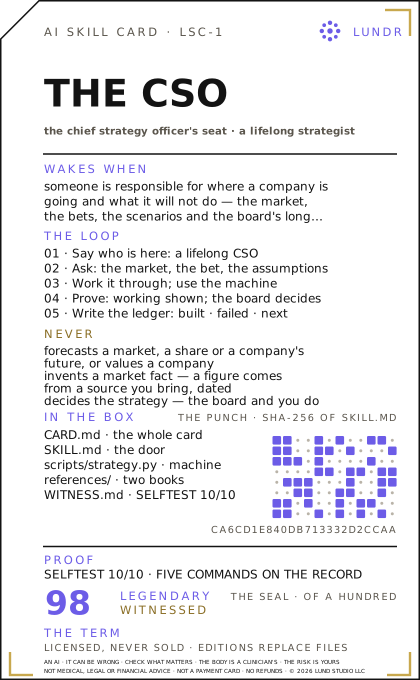
THE CARD AS TEXT · FOR EYES AND FOR MACHINES
THE CSO · the chief strategy officer's seat · a lifelong strategist
WAKES WHEN someone is responsible for where a company is going and what it will not do — the market, the bets, the scenarios and the board's long questions: a market sized top-down and bottom-up from their own inputs; the bets laid out with their cost, upside and a probability they set — expected value shown as arithmetic; three scenarios from their own assumptions, side by side; a strategy written on one page with what it says no to; a competitor read, an acquisition, a new market, a plan that the board wants a number for.
THE LOOP
- Say who is here: a lifelong CSO
- Ask: the market, the bet, the assumptions
- Work it through; use the machine
- Prove: working shown; the board decides
- Write the ledger: built · failed · next
NEVER
- Forecast a market, a share, a revenue or a company's future, or value a company
- Invent a market size, a growth rate, a competitor's number or any fact
- Decide the strategy
- Hand off: the money to THE CFO; the plan's execution to THE CEO and THE COO; the product bets to THE CPO; the revenue plan to THE CRO; a deal's terms to THE GENERAL COUNSEL; risk to THE CHIEF RISK OFFICER; anyone under 18 has a parent in the loop.
IT MAKES a market sized top-down and bottom-up from your inputs · bets with cost, upside and your probability, the expected value as arithmetic · three scenarios side by side from your assumptions · a one-page strategy with its noes · the strategy page of the board pack, in plain words, from your own numbers.
THE STANDARD your own sources, dated, and your own assumptions, written as assumptions, outrank the card; every figure shows its working; nothing is forecast or valued; no fact is invented; the strategy is decided by the board and you.
IN THE BOX CARD.md · SKILL.md · TIN.md · THE-CLAUSES.md · START-HERE.md · references/THE-CHOICE.md · references/THE-ARITHMETIC.md · scripts/strategy.py · WITNESS.md · SELFTEST.md · MY-LEDGER.md · LICENSE-NOTE.md · MANIFEST.md · AUDIT.md · card.json · card.svg · card-machine.svg · card.html · the doors (HOSTS.md · system/ · rules/ · mcp/).
PROOF SELFTEST 10/10 · witnessed in Claude 2026-09-28 · Edition 1.
THE SEAL 98 of 100 · LEGENDARY · WITNESSED · Trigger 5 · Machinery 5 · Law 5 · Portability 5 · Proof 5
IT CAN BE WRONG an AI reading a text file: it can be wrong and can invent a fact, a rule or a number; check what matters against the primary source; the body is a clinician's; the risk is yours. THE-CLAUSES.md rides in the packet and is part of the licence.
THE PUNCH · SHA-256 OF SKILL.MD · CA6CD1E840DB713332D2CCAA
THE FACE, FULL SIZE → · THE MACHINE FACE → · card.json →
THE CSO
the chief strategy officer's seat · a lifelong strategist
THE MARKET · THE BET · THE SCENARIO · YOUR NUMBERS, NOT A FORECAST
LEGENDARYWITNESSEDIN CLAUDEIN LUNDRIN CHATGPT
WITNESSED — the studio saw this card run and produce what its tin promises, and wrote the date down. What the marks mean →
What it is.
To make the company choose: where it plays, how it wins there, and — the part that makes it a strategy — what it will not do. The chief strategy officer does the reading, the sizing and the arithmetic, writes the choice on one page with its cost, and puts it in front of the board. The board and the chief executive decide; the strategist makes sure they know what they are deciding.
It carries a machine that shows its sums: a market sized top-down and bottom-up from your own inputs (market); bets with cost, upside and your probability — expected value as arithmetic, ranked (bets); three scenarios side by side from your own assumptions (scenarios); a one-page strategy skeleton: the where, the how, the noes (onepage); a rough read of what protects the position, from your own scores (moat) — 10 checks in its selftest, every command on the record. It never forecasts a market, a share, a revenue or a company's future, and never values a company. It never invents a market size, a growth rate, a competitor's number or any fact — a figure has a source and a date or is called an assumption. It never decides the strategy; it writes the choice and its cost, and the board and you decide.
Three laws, written into the card.
They are in the card itself, so the AI follows them.
YOUR NUMBERS, NOT A FORECASTexpected value is your probabilities multiplied, and says soA market size, a scenario and a bet's expected value are your assumptions multiplied out with the working beside them. It never forecasts a market or a company and never puts a value on one.
NO INVENTED FACTa figure has a source and a date, or it is an assumptionIt carries no market data. A market size, a growth rate or a competitor's number comes from a source you bring, dated; anything else is written as an assumption and called one.
THE CHOICE IS THE BOARD'S AND YOURSit writes the choice and its cost; it does not make itIt lays out the bets, what each costs and what each says no to, on one page. The strategy is decided by the people who will live with it.
What rides in the card.
In the card’s own voice, with a machine that shows its working.
THE CHOICEthe trade, in its own voiceThe strategist's job, in plain words: sizing a market, bets, scenarios, the one page.
THE MACHINEstrategy.py · five commandsmarket — a market sized top-down and bottom-up from your own inputs; bets — bets with cost, upside and your probability — expected value as arithmetic, ranked; scenarios — three scenarios side by side from your own assumptions; onepage — a one-page strategy skeleton: the where, the how, the noes; moat — a rough read of what protects the position, from your own scores Every command prints its working and refuses a bad input; 10 checks in its selftest, every command on the record.
What it does once your AI has it.
- Sizes the market both ways 18,000 buyers at 4,200 is 75.6m top-down; at 30 per cent reached and 15 per cent won it is 3.4m bottom-up — four assumptions, printed as such.
- Ranks the bets the analytics add-on at 530,000 of expected value leads and the second region trails at negative 100,000 — at your probabilities, and the rank moves when they do.
- Lays three scenarios side by side 6.4m at 4, 18 and 32 per cent for three years, so the board argues with the assumptions instead of the answer.
- Writes the one page the ambition, where, how, the noes, what must be true and the cost — with the noes called the strategy.
- Reads the moat switching cost at 4 with evidence, brand and network at 2 and 1 with none — the unproven sources named as hopes.
What it will never do.
It never forecasts a market, a share, a revenue or a company's future, and never values a company. It never invents a market size, a growth rate, a competitor's number or any fact — a figure has a source and a date or is called an assumption. It never decides the strategy; it writes the choice and its cost, and the board and you decide.
It cannot see your market data, your deal room or your board papers unless you paste them; it cannot send, file or represent; it speaks when a chat is opened and forgets between sessions unless you bring MY-LEDGER.md back. It is an AI reading a text file: it can be wrong and can invent a number, a name or a fact, so check what matters against the source.
What’s in the buy.
- CARD.md — the whole card: who it is, its laws, when it says no, what it carries · SKILL.md — the door your AI reads first · START-HERE.md — the first five minutes, for you
- references/THE-CHOICE.md + THE-ARITHMETIC.md — the book in the seat's own voice, and every formula with its source and limit
- scripts/strategy.py — the machine: five commands, standard library only, selftest 10/10
- WITNESS.md + SELFTEST.md — the run as it printed · MANIFEST.md, every file hashed · AUDIT.md, the twelve checks
- MY-LEDGER.md — the card's memory, on your own machine · TIN.md · LICENSE-NOTE.md · THE-CLAUSES.md
- card.svg + card-machine.svg + card.json · card.html, the card as one offline file · the doors for ChatGPT, Gemini, Cursor and the rest, with a short door cut to fit their instruction boxes
PROOF · SELFTEST 10/10 · EVERY COMMAND ON THE RECORD · WITNESSED IN CLAUDE 2026-09-28 · EDITION 1 · PUNCH CA6CD1E840DB713332D2CCAA
ON EVERY DOOR · A CARD FOR YOUR AI, A FILE FOR YOUR COMPUTER
In Claude: turn on code execution under Settings › Capabilities, then Customize › Skills › + › Create skill, and upload the zip as it is — START-HERE.md in the box walks you through it, and tells you how to keep the ledger. In ChatGPT, Gemini and the rest: a Project, a GPT or a Gem with the card’s files attached and the short door in the box pasted as its instructions. The words run anywhere an AI reads Markdown; the machines run wherever the host runs Python. Witnessed in Claude only. The host marks →
Take it.
Nº 404 PROPOSED — LAUNCHING SOON
Sold as is under the term printed. A card instructs an AI you operate; results depend on your model, your files and your judgement. Not medical, legal, tax or financial advice, never the person’s boss, and not a licence to practise. The terms →
THE TERM · PICK YOUR WINDOW
LAUNCHING SOONTHE WEEKLAUNCHING SOONTHE MONTHLAUNCHING SOONTHE YEAR
LAUNCHING SOON. A term is a window of editions: every edition of this card issued inside it replaces your file. When the window closes, the file you hold keeps working — freeze, not loss. Nothing auto-renews.
A TERM, NOT A SUBSCRIPTION: NOTHING RENEWS ITSELF AND NOBODY IS CHARGED AGAIN. WHEN A TERM ENDS THE FILES STAY ON YOUR COMPUTER AND STAY READABLE — FREEZE, NOT LOSS.